Tested on real shots
Kling vs Seedance 2.5 on four real logo swaps, with the receipts
I gave both models the same four shots and the same prompts, scored the first attempt, and kept every bill. Neither one is ready to hand to a finishing editor, and they fail in opposite ways.
Most comparisons of AI video models are rate cards or showreels. I wanted to know something narrower: if a brand team hands you a finished shot and asks you to swap one logo, what do Kling and Seedance 2.5 actually give back, and what does it cost?
The short version
- Kling picks the right target but makes labels look stuck on. It changed the right object in every test, but the bottle label came out as a flat card and the billboard tagline was garbled.
- Seedance makes surfaces look real but edits the wrong things. Its bottle label wraps the glass and catches the light. It also relabelled all three bottles when asked for one, and it left the billboard untouched while redrawing the rest of Times Square.
- Both garble or drop small text, and both re-render every pixel of the shot, including the parts you asked them to keep.
- Seedance costs four to five times as much as Kling at 1080p, because it bills your input video as well as its output. At 480p the gap closes.
The test
Four clips, each with one branded object to replace with a reference logo for a made-up skincare brand, LUNE:
| Case | Shot | What it tests |
|---|---|---|
| Bottle | A hand lifts one of three red-labelled bottles (1080p, 3.1 s) | A curved label, among identical objects |
| Billboard | Times Square at night; replace the pink PANDORA board (1080p, 5 s) | A small target in a busy wide shot |
| Robe | A woman in a waffle robe; add a logo to the left chest (720×966) | Printing on fabric that moves |
| Cap | A logo on a baseball cap | A curved logo that fills much of the frame |
The rules:
- Same prompt for both models, for example: "Replace the red label on the bottle the hand lifts with the label in the reference image. Keep the other bottles and everything else in the video exactly the same."
- The whole frame goes in. No masks, no crops.
- The first attempt is the one scored.
- Seedance needs at least 4 seconds of input and Kling at least 3, so short clips were padded by holding the last frame. Only the original frames are judged.
Kling ran as Omni on Kling's own site. Seedance 2.5 ran on BytePlus's API, at 1080p for the bottle and billboard and 720p for the robe and cap.
Bottle: Kling targets, Seedance renders
Kling did what was asked: it changed the bottle the hand lifts and left the other two red. But the new label is a flat rectangle that doesn't wrap around the glass and runs past its edge. The brand name is right; the next line reads "HYDJATING SERUM", and the two small lines below are noise.
Seedance relabelled every bottle on the table. On the bottle that was meant to change, though, the label looks printed: it follows the curve and picks up the sheen of the glass, and it keeps wrapping as the bottle turns in the hand. "LUNE" and "HYDRATING SERUM" are right at rest. A few mid-lift frames read "HYERATING", and the two small lines are gone.
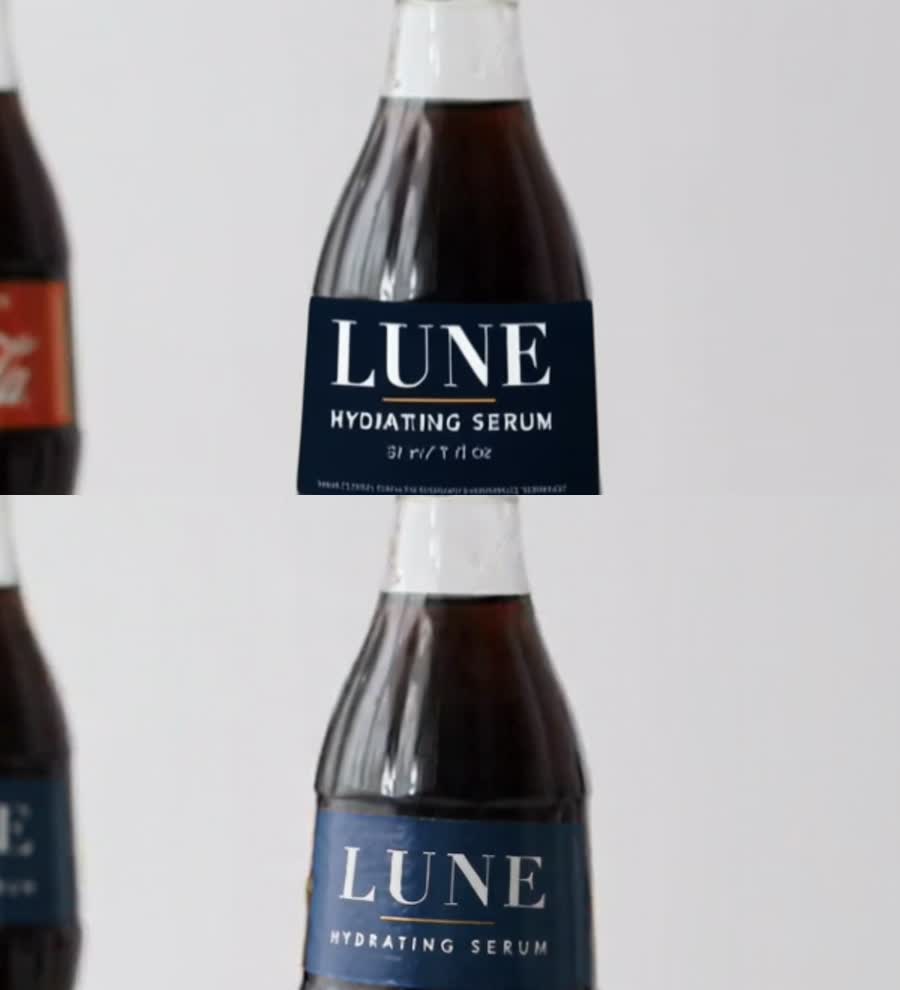
For context, the label is about 190×120 px in the source. The bottom line of text would be about 4 px tall. Nobody can read that in the finished shot whoever draws it, so the fair test is the top two lines.
Billboard: Seedance didn't make the change
Kling replaced the board. "LUNE" is clean; the tagline below it came out as something like "Stίlh ıowda Ssnjc".
Seedance's output looks, at first glance, like nothing happened. The PANDORA board is still there. But it isn't the original footage: every pixel was redrawn. Measured against the source, the crowd and the other billboards score about 19–23 dB, where simply re-encoding the clip once scores 40–44 dB. (These are PSNR figures on brightness, measured on patches away from the target; higher means closer to the original.) The output is also 113 frames instead of 120, so the shot plays about 6% faster, and it has an audio track that the source didn't.
So a finishing editor would get back a retimed, redrawn copy of their shot without the change they asked for.
Robe and cap: both models draw the badge, neither places it well
The robe was the case where I expected the models to do well, because the logo is large. On accuracy, they did. Both drew the badge text correctly. But both put it on her right chest; on clothing, "left chest" usually means the wearer's left. Seedance's badge is also oversized and flat, without the waffle weave showing through. Kling changed the format, delivering the 720×966 clip as 720×1280.
On the cap, Seedance drew "EST. 2319" instead of "EST. 2019", the same small-text failure at a different size. Kling's cap run used a different clip, so I haven't compared the two.
The pattern
| Kling Omni | Seedance 2.5 | |
|---|---|---|
| Changes the right object | Every time | Changed extra bottles; missed the billboard |
| Looks part of the surface | Flat, stuck-on labels | Labels wrap and catch the light |
| Small text | Garbled | Dropped, or a digit swapped |
| Rest of the shot | Re-rendered | Re-rendered |
| Format | Changed framing on the robe; frame counts off by one or two | Retimed the billboard; added or dropped audio; upscaled the robe |
Each model's weakness is the other's strength. Seedance renders a surface better; Kling follows the instruction better. Neither keeps the parts of the shot you didn't ask to change, and for professional work that matters as much as the logo. An editor can't drop a fully re-rendered shot into a graded timeline and trust it.
What it actually costs
I expected Seedance to be the cheaper option. The receipts said otherwise.
Seedance on BytePlus bills in tokens, and every receipt matched this rule exactly:
tokens = (input frames + output frames) × (output width × output height ÷ 1024)- Input frames are counted at 24 per whole second of your source, whatever its frame rate.
- Output resolution sets the cost of every frame, input included. A 1080p frame is 2,025 tokens; a 480p frame is about 400.
- The rate with a video supplied is $6.40 per million tokens at 480p and 720p, and $7.00 at 1080p. Without a video it's $10.70 and $11.70.
| Run | Input + output frames | Tokens | Cost |
|---|---|---|---|
| Bottle, 1080p | 96 + 97 | 390,825 | $2.74 |
| Billboard, 1080p | 120 + 113 | 471,825 | $3.30 |
| Robe, 720p | 96 + 97 | 174,269 | $1.12 |
| Cap, 720p | 96 + 97 | 173,700 | $1.11 |
| Billboard again, 480p | 120 + 113 | 93,272 | $0.60 |
Three things the per-second list prices don't tell you:
- Your source video is billed too, at the output resolution. A 5-second edit counts 10 seconds of frames. The lower rate for video input only partly makes up for it.
- Padding is billed on both sides. Taking the 3.1-second bottle clip to Seedance's 4-second minimum added about $0.60 to that run.
- Resolution is the big lever. Per second of edit, Seedance costs about $0.68 at 1080p, $0.28 at 720p and $0.12 at 480p.
Kling charges per second regardless of resolution: about $0.16–0.18 a second on Kling's site, or about $0.13 for Kling O3 standard through Fal. At 1080p Seedance costs four to five times as much. At 480p the two are level.
The same 480p edit elsewhere
Seedance 2.5 is also sold through other platforms. Here's what the 480p billboard edit above (5 seconds in, about 4.7 out) would cost on each, from their published rates in October 2026:
| Where | Cost |
|---|---|
| BytePlus API (my receipt) | $0.60 |
| Higgsfield API | $0.84 at its current launch discount; $1.20 at list |
| Fal | $1.20 |
| Runway | about $1.44–1.50 |
Fal and Higgsfield use the same token formula as BytePlus at a higher rate, so those two figures are exact for this job. Runway charges credits per output second plus a smaller charge per input second. One caveat on BytePlus: its international API isn't sold in every country, the US included, so check before you plan around it.
An afterthought: small text is a pixel problem
Looking at the billboard, the garbled tagline isn't really a model failure. In a 1080p frame the board is only about 250 px wide, so the generator has a few pixels per letter. Asking for a higher resolution doesn't help much, because the board stays the same fraction of the frame.
What does help is giving the generator less to look at. If you crop a window around the board, scale it up, and send only that, the generator draws the board large. You then shrink the result back and put only the board into the original frames. Everything else stays the source footage, untouched.
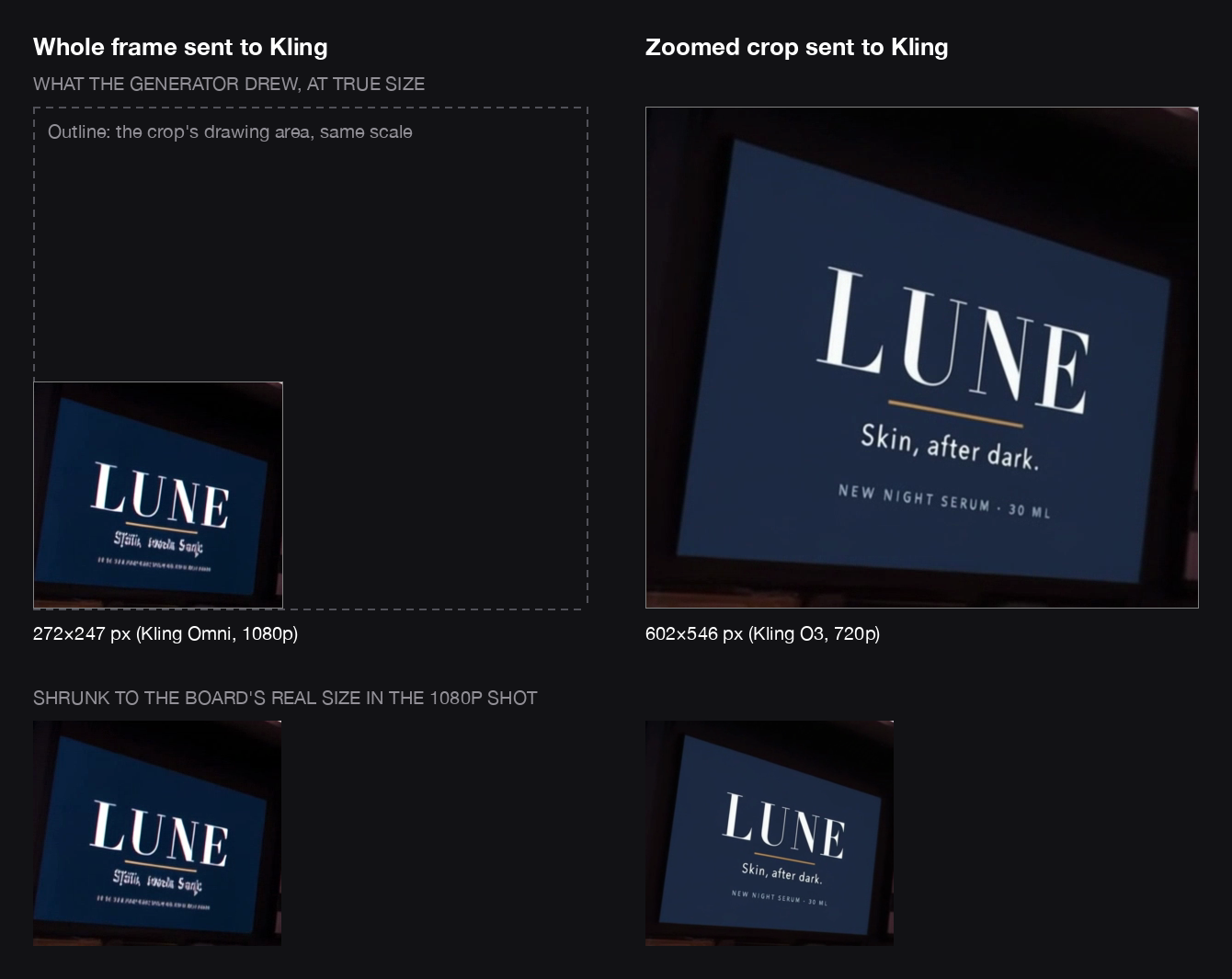
With Kling, this got every word right on the billboard and the bottle, and because only the target is put back, the crowd, the other bottles and the timing stay the original footage. It also changes the cost picture for Seedance: a 720p generation of a crop draws the board about 2.2× larger per side than a 1080p whole-frame run, at about 40% of the price.
It isn't free of trade-offs. When the target already fills the frame, like the cap, there's little to gain. When it moves a lot, like the lifted bottle, the window has to hold the whole movement, which limits the zoom.
This is the direction I'm building in Rove. I haven't run Seedance through it yet; that's the next test.
Limits
- One run per model per case, on stock clips I chose. Results on your own footage may differ.
- Scores come from stills. I haven't yet scored how well each logo stays on its surface in motion.
- Kling ran as Omni on its own site, not the pro tier.
- The cap comparison uses different clips for each model.
- Prices are as published or billed in October 2026, and launch discounts change.
Next
The next round runs Seedance on the zoomed crop at 720p and 480p, scores every output in motion, and adds models as they ship. Same four shots, same prompts, same receipts. If you have a shot you'd like to see tested, send it over.